What Animals Are in Nairobi National Park? A Local Likelihood Guide
Nairobi National Park sits inside the same city limits as the office towers you can see from its plains, yet it holds one of Kenya's most dependable wildlife circuits within an hour of any hotel in town. First-time visitors often arrive with a mental checklist copied from a different, more famous park, and get thrown off when a few names on it never turn up here at all. What actually happens on a typical morning follows honest, repeatable patterns rather than a marketing promise: some animals show up on nearly every drive, a few need real luck, and one very famous African animal is simply not part of this ecosystem. We drive this circuit most weeks of the year, so this guide ranks every animal you might see by how often we genuinely see it, names the part of the park where each one tends to show up, and clears up the one mix-up that catches almost every visitor. Compare every wildlife viewing tours in Nairobi option before you book.
Quick answer
On a typical Nairobi National Park drive you'll almost always see zebra, impala and buffalo, very often a rhino near the forest edge, and on a good day a cheetah crossing the open plains at dawn. Lions turn up on a regular but not every drive basis, and one animal nearly every visitor expects, the elephant, does not live in this park at all.
Key takeaways
- Zebra, impala, Thomson's gazelle, buffalo, giraffe and ostrich turn up on nearly every drive
- Rhino sightings here are more consistent than in most Kenyan parks, this park's real specialty
- Lions are a regular but not every drive sighting rather than a certainty
- There are no elephants in this park at all, the orphanage next door fills that gap
- There is no wildebeest mega-migration either, only a smaller local movement toward the Athi-Kapiti plains
- See the likelihood table below for exactly where and when to look for each animal
Your Real Chances, At a Glance
A shorter cut at the same picture, before the full species-by-species breakdown below.
| Animal | Chance on a morning drive |
|---|---|
| Zebra | almost certain |
| Giraffe | very high |
| Buffalo | very high |
| Rhino | very good, this park's specialty |
| Lion | good, mornings help |
| Cheetah | moderate, a lucky day |
| Leopard | rare |
The full species-by-species detail, with exact locations and months, follows below.
At a Glance: Every Animal Ranked by Likelihood
The rows below are ordered by how often we actually see each animal, not alphabetically, and every likelihood uses one of five fixed terms so nothing here reads as a promise it can't keep.
| Species | Where in the park | Best months | How likely |
|---|---|---|---|
| Zebra (punda milia) | Open plains throughout the park | Present year-round | Nearly every trip |
| Impala and Thomson's gazelle | Open grassland and forest edge | Present year-round | Nearly every trip |
| Cape buffalo (nyati) | Open plains near the dams | Present year-round | Nearly every trip |
| Maasai giraffe (twiga) | Forest edge and open bush | Present year-round | Nearly every trip |
| Ostrich | Open grassland | Present year-round | Nearly every trip |
| Rhino, white and black (kifaru) | Forest-edge circuit, western side | Year-round, clearest June through October and January to February | Most trips |
| Eland | Open plains | Present year-round | Most trips |
| Kongoni (Coke's hartebeest) | Open plains | Present year-round | Most trips |
| Hippo (kiboko) | Hippo Pools | Present year-round | Most trips |
| Grey crowned crane | Grassland near seasonal pools and the dams | Year-round, most visible November through April | Most trips |
| Lion (simba) | Open plains and near the dams, eastern boundary | Year-round, most active at dawn | Regular but not every trip |
| Cheetah | Open central plains | Year-round, cooler morning light best | Lucky-day sighting |
| Serval | Grassland edges, active at dawn | Present year-round | Lucky-day sighting |
| Black-backed jackal | Open plains, active at dawn | Present year-round | Lucky-day sighting |
| Leopard (chui) | Forest and riverine cover | Present year-round | Rare |
Crocodiles share the Hippo Pools with the hippos, and more than 400 bird species have been recorded here, with migrant species arriving between November and April. The four tiers below go through each animal one at a time, then Where Each One Lives further down flips the same information around by location instead of species.
On Almost Every Drive
These five turn up often enough that a morning without any one of them would be unusual.
Zebra (Punda Milia)
One-line ID: black-and-white striped, herd animal, grazing in open groups. Exact where: open plains throughout the park, especially along the main circuit near the gate. When: no real season, present year-round.
Likelihood: nearly every trip. The memorable part is that each zebra's stripe pattern is unique, like a fingerprint, and they often graze alongside giraffe or buffalo for shared predator lookout. Best hour: no strong pattern, visible steadily through the day.
Impala and Thomson's Gazelle
Impala are reddish-brown with a black side stripe and lyre-shaped horns on the males, Thomson's gazelle is smaller with a bold black horizontal stripe. Where: open grassland and forest edge along most tracks. When: present year-round.
Likelihood: nearly every trip. Thomson's gazelle has a genuine party trick worth watching for, a stiff-legged bounce called stotting that signals fitness to a watching predator rather than fear. Any of our morning game drives pass through this open grassland stretch within the first half hour.
Best hour: no strong pattern, visible steadily through the day.
Cape Buffalo (Nyati)
One-line ID: heavy, black-horned bovine, older bulls carry a fused bony boss across the forehead. Where: open plains near the dams. When: year-round, herds often larger in the dry months near shrinking waterholes.
Likelihood: nearly every trip. Old bulls pushed out of the herd, known locally as dagga boys, are the ones guides watch most closely, since a lone buffalo is considered the least predictable animal on the whole circuit. Best hour: no strong pattern, visible steadily through the day.
Maasai Giraffe (Twiga)
One-line ID: tallest land animal, jagged brown patches with cream edges. Where: forest edge and open bush throughout the park. When: present year-round.
Likelihood: nearly every trip. Giraffe sleep less than two hours a day, often standing, and males settle dominance through slow, swinging neck contests rather than any real fighting. The full-day combination tour pairs this game-drive sighting with hand-feeding at the Giraffe Centre later the same afternoon.
Best hour: no strong pattern, visible steadily through the day.
Ostrich
One-line ID: the tallest living bird, males black-bodied with white wingtips, females a duller brown. Where: open grassland, usually in small groups. When: present year-round.
Likelihood: nearly every trip. A male ostrich keeps a single communal nest where several females lay, and he alone sits on it through the coldest overnight hours, one of the few birds anywhere that incubates through the night. Best hour: no strong pattern, visible steadily through the day.
Most Drives
One step down from certain, but still the outcome on most mornings we drive.
Rhino (Kifaru)
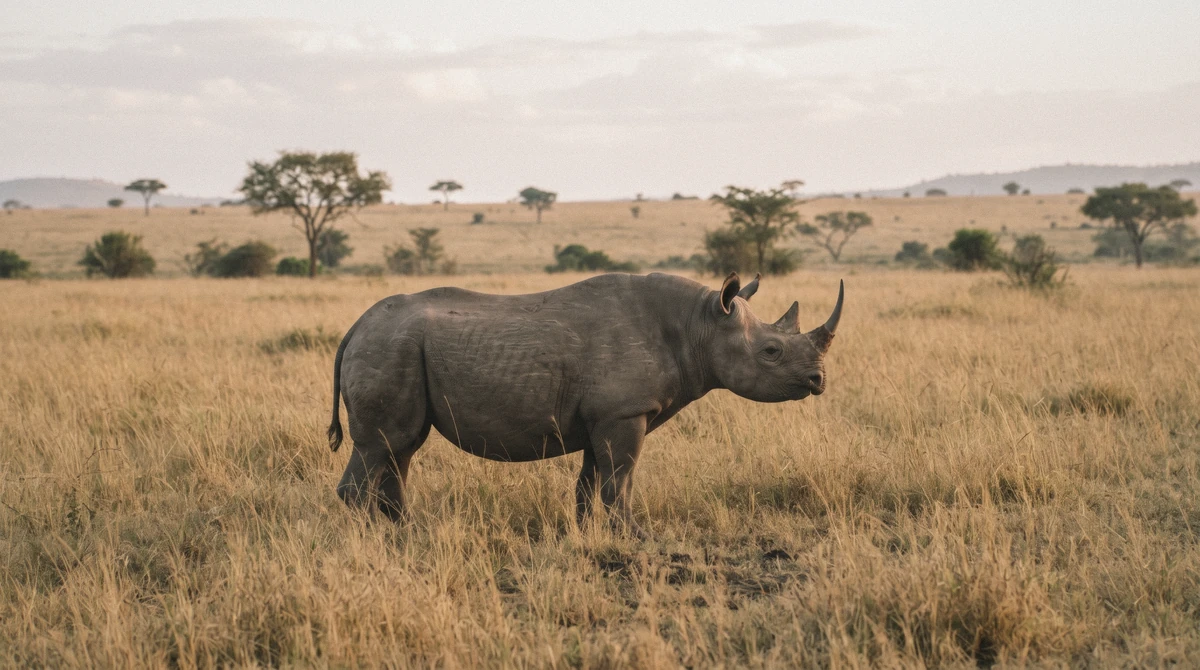
Both white rhino, square-lipped grazers, and black rhino, hooked-lipped browsers, live along the forest-edge circuit on the park's western side. When: year-round, clearest during the June through October and January to February dry stretches when grass is short. Likelihood: most trips, and genuinely this park's specialty, often more reliable here than in many larger Kenyan parks.
Black rhino are famously short-sighted and hunt almost entirely by scent, so a stationary, downwind vehicle can watch one graze within meters without it ever noticing the audience. Best hour: mid-morning, once grazing brings them into open ground.
Eland
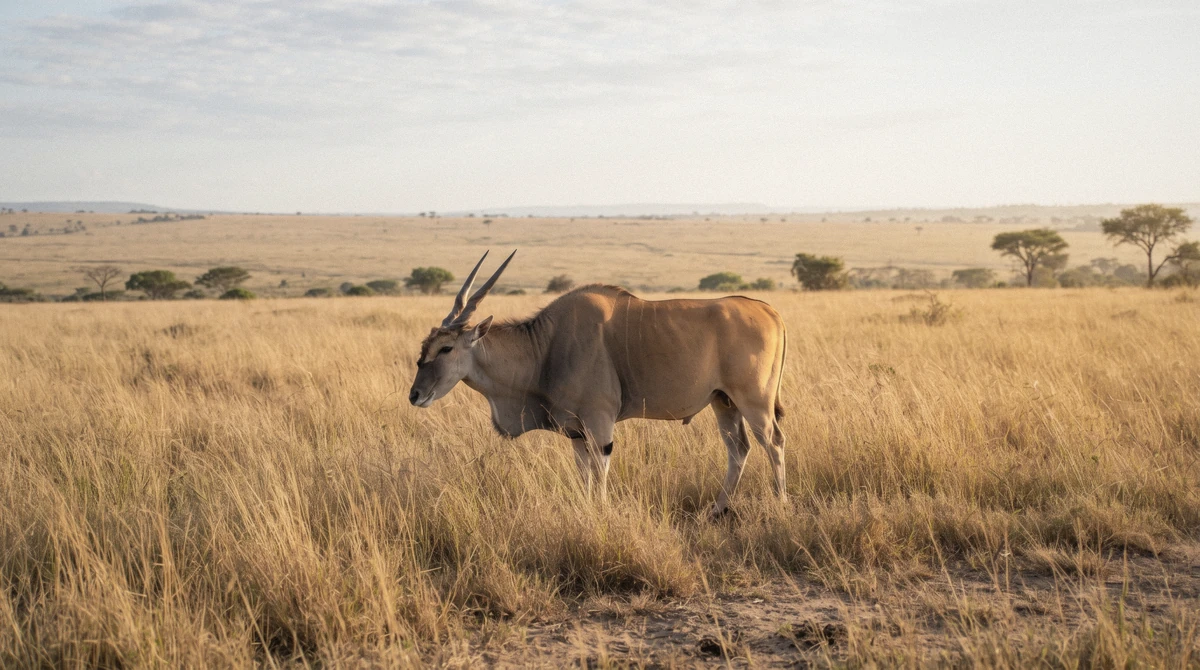
One-line ID: the largest African antelope, spiral horns on both sexes, a loose dewlap under the throat. Where: open plains. When: present year-round.
Likelihood: most trips. Eland can clear a two-meter fence from a standing start despite weighing as much as a small car, and a sharp knee-tendon click audible at close range is thought to signal rank within the herd. Layover safaris heading straight for the open plains often catch eland in the same stretch as the rhino. Best hour: no strong pattern, visible steadily through the day.
Kongoni (Coke's Hartebeest)
One-line ID: an elongated face, ringed lyre-shaped horns, a noticeably sloped back. Where: open plains alongside eland and zebra herds. When: present year-round.
Likelihood: most trips. A kongoni will often post itself on top of a termite mound, the highest ground on offer, scanning for predators while the rest of a mixed herd keeps grazing below. Best hour: no strong pattern, visible steadily through the day.
Hippo (Kiboko)
One-line ID: barrel-bodied, mostly submerged, eyes and ears breaking the surface. Where: Hippo Pools, the one stop reached on foot on the ranger-led walk. When: present year-round.
Likelihood: most trips. Hippos spend nearly all daylight hours underwater and only really move onto land to graze after dark, so a daytime sighting is genuinely a pair of ears and nostrils rather than the whole animal. The dams loop on the full-day tour times the walk to the Hippo Pools around mid-morning, while hippos are still visible near the bank.
Best hour: the mid-morning pools walk, the one window they're genuinely visible.
Grey Crowned Crane
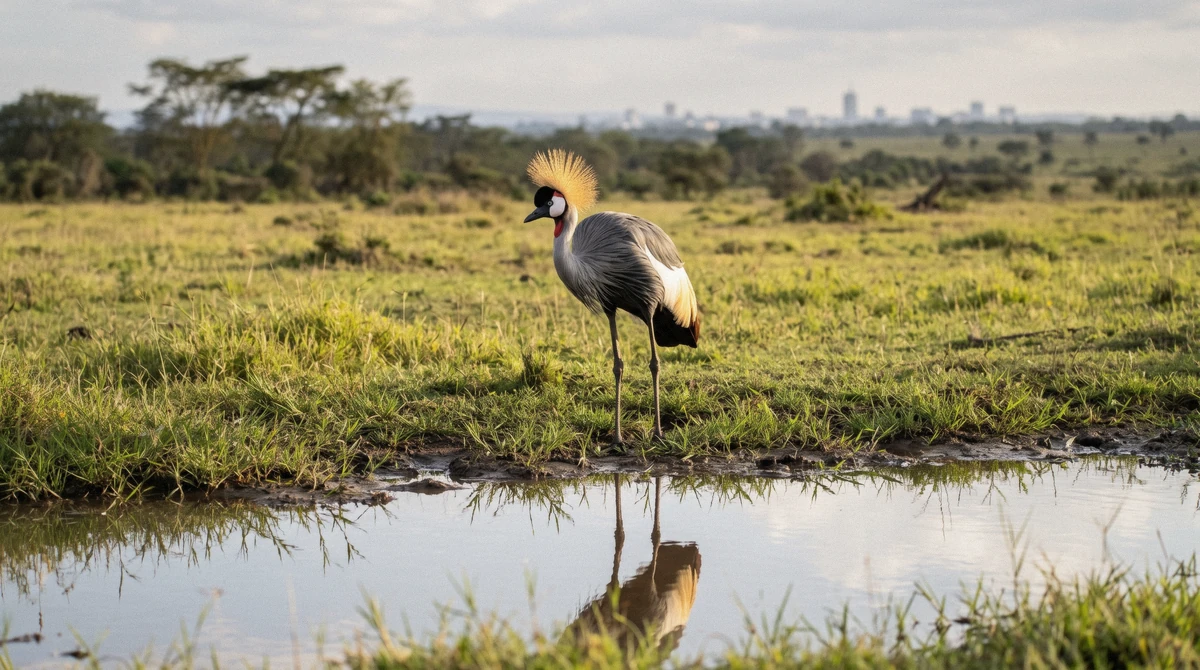
One-line ID: a slate-grey body, a golden spiked crest, a bare red throat patch. Where: grassland near seasonal pools and the dams. When: present year-round, most visible November through April alongside the migrant bird season.
Likelihood: most trips. Its courtship display, bowing, jumping, wing-flapping, happens year-round rather than only in a set mating season, so a dance is genuinely possible on almost any visit that finds a pair together. Best hour: no strong pattern, visible steadily through the day.
Lion (Simba)
One-line ID: tawny-coated, maned on adult males, usually seen resting in shade or moving along open ground. Where: open plains and near the dams, especially the eastern boundary. When: present year-round, most active at dawn before the heat sets in.
Likelihood: regular but not every trip. A resting pride can stay flattened in short grass for hours, and the first giveaway is usually a black ear-tip flicking at flies rather than the whole animal shifting position. Best hour: the first hour after the gate opens, before the heat settles in.
The Lucky-Day List
This is the part of the drive where a genuinely rare sighting is possible, and the honesty is the point rather than a disclaimer tacked on afterward.
Cheetah
One-line ID: slender build, black tear-line markings running from the eyes, built for speed rather than power. Where: open central plains. When: present year-round, cooler morning light best.
Likelihood: lucky-day sighting. A cheetah's spine flexes like a spring during a full sprint, covering close to seven meters in a single stride, though most sightings here are a resting cat scanning the plains rather than an actual chase. Best hour: the first 90 minutes after the gate opens.
Serval
One-line ID: slender and long-legged with a small head and oversized rounded ears, leopard-like spotting. Where: grassland edges, most active at dawn. When: present year-round.
Likelihood: lucky-day sighting. Those oversized ears let a serval pinpoint a rodent moving underground, and its signature move is a near-vertical pounce straight down into the grass. Early morning game drives that leave the gate right at opening carry the better odds for this one, since servals tend to retreat as the morning warms.
Best hour: right at gate opening, before the day warms up.
Black-Backed Jackal
One-line ID: a reddish-brown coat with a black saddle running down the back. Where: open plains, active at dawn and dusk. When: present year-round.
Likelihood: lucky-day sighting. Jackals pair for life, and a mated pair often hunts in a loose, coordinated pattern, one flushing prey toward the other, a genuine partnership visible if you catch them working together in the first light. Best hour: early morning or last light, both crepuscular windows.
Leopard (Chui)
One-line ID: a rosette-spotted coat, powerful build, almost always alone. Where: forest and riverine cover, rarely near the open tracks. When: present year-round.
Likelihood: rare. A leopard can haul a kill heavier than itself up into a tree in a single climb, and most confirmed sightings on this circuit are a tail hanging from a branch rather than the cat itself on the ground. Best hour: no reliable window, sightings come down to chance more than timing.
When and Why: Animal Behaviour on the Clock
The tiers above say what you'll see. This part covers why the clock matters as much as the calendar for a handful of animals.
Lions: why mornings win
The cool hours at the start of the day overlap the tail end of a night's hunting, so a pride is often still active, or freshly fed and resting in the open, right around dawn. By 10:00 the heat has usually pushed them to flatten into the grass, where a black ear-tip is often the only visible sign of a whole pride nearby.
Rhinos: why they stand in the open
Both white and black rhino are grazers and browsers of short grass, and they work the open edges early in the day while the ground is still cool underfoot. That habit is why the forest-edge circuit keeps producing sightings well into mid-morning, past the point other grazers have already drifted toward shade.
Cheetahs: the dawn window
Cheetah hunt by sight in daylight, and they deliberately avoid the same open ground once lions become active later in the morning. The first 90 minutes after the gate opens is genuinely their working window, before the heat and the competition both set in.
Hippos: why you only see ears
Daylight is water time for a hippo, spent almost entirely submerged with only ears and nostrils breaking the surface. The Hippo Pools walk shows more of the animal than the drive itself ever does, since it's the one stop where you're standing close enough to actually watch the water rather than glancing at it from a moving vehicle.
What You Won't See, Honestly
Two expectations trip up almost every first-time visitor here, and both trace back to the same source, a mental image borrowed from a different, more famous park rather than this one.
The first is elephants. Nairobi National Park has none, and it never has, since a boundary this close to a city of millions cannot safely support a herd of that size year-round. The gap is filled deliberately: the David Sheldrick elephant orphanage sits a short drive from the main gate and raises orphaned calves through a daily public hour, the closest elephant encounter this side of the city has to offer.
The second is the wildebeest migration. The river-crossing spectacle that made the Masai Mara famous does not happen here. This park's much smaller herds follow a local pattern instead, moving between the park and the open Athi-Kapiti plains to the south as rain and grass shift through the year. It's a real, quieter movement worth knowing about, just not the one from the documentaries, and neither confusion is anything to feel embarrassed about since both parks share a name that suggests more overlap than actually exists.
Responsible Wildlife Viewing
Kenya Wildlife Service rules apply to every vehicle on the circuit, and they exist because this ecosystem sits closer to a city than any other national park on earth. Stay inside the vehicle at all times except on the ranger-led Hippo Pools walk, keep a respectful distance and let your guide decide how close is close enough, and never feed any animal, including the vervet monkeys and baboons around the gate and picnic areas, since a hand-fed animal is a genuine safety risk to the next visitor as much as itself. No flash photography at close range, engines off once a guide has settled at a sighting, and no driving off the marked tracks for a better angle, a rule that protects both the grassland and the animal's own space to move away if it chooses to.
Where Each One Lives: Spots and Sites
The tiers above organized everything by species. This section flips the same information around by location, since where you are on the circuit changes what shows up as much as the calendar does.
- Forest-edge circuit, western side: this is rhino territory, and the one part of the park where leopard occasionally turns up along the tree line. Giraffe browse the same edge. The david Sheldrick combination tour routes through here early, before the morning's second stretch.
- Open plains and near the dams: lion, buffalo, eland and kongoni cluster here, and it's the best stretch for a cheetah sighting on a lucky morning. This is also the busiest section of any shared game drive, simply because it holds the most animals per square kilometer.
- Hippo Pools: hippo and crocodile share the water, and it's the single spot on the whole circuit reached on foot, via a short ranger-led walk rather than from the vehicle.
- Open grassland: ostrich, zebra and gazelle graze here in the open, and crowned crane favor the grass near seasonal pools closer to the dams. The private tour can hold this stretch as long as a good sighting keeps developing, since the pace belongs to your group alone.
Where Each Animal Is Usually Seen
The same information from the sections above, organized by place on the map rather than by species.
When to See Them
Most of what's on this page holds true in any month, since the park's resident species don't leave. The one genuinely sharp seasonal swing is birdlife: migrant species arrive from November through April and are simply not present the rest of the year, so a birding-focused visit is worth timing to that window specifically. Beyond that, dry-season months, June through October and January to February, concentrate animals near shrinking waterholes and keep grass short enough for easier sightings across the board, while the long rains from March through May let grass grow tall enough to screen ground-level game from anything but a close pass.
For the full month-by-month breakdown, see our best time to visit Nairobi National Park guide.
How to Maximize What You See
We've found a handful of habits genuinely change what a morning here produces, more than luck does.
- Arrive for the 6:00 gate opening. It's the single biggest lever on this whole list, and it costs nothing extra.
- Ask your guide directly what's been seen that morning. Drivers share sightings constantly over the radio between vehicles, and a specific question often redirects the whole route toward something worth seeing.
- Stay quiet once the vehicle stops. Sound carries further than you'd expect across open grassland, and a hushed vehicle holds a sighting longer before the animal moves off.
- Scan the horizon as much as the road ahead. Cats and rhino are often spotted first as a shape at real distance, long before the vehicle gets anywhere close.
- Bring binoculars rather than relying on a phone's zoom. A fair share of the Most Drives tier sits at genuine distance rather than arm's reach.
- If you're traveling with children, our Nairobi National Park with kids guide has a simple spotting checklist that turns a quiet back seat into a game.
Frequently Asked Questions
What's the most common animal you'll actually see on a Nairobi National Park drive?
Zebra, impala, Thomson's gazelle, buffalo and giraffe. All five turn up often enough that a morning missing every one of them would be unusual, and ostrich are close behind on open grassland.
Will I definitely see a lion in Nairobi National Park?
Not on every drive, no. Lions here sit in the regular but not every trip tier, less certain than the rhino sightings this park is known for, but still a realistic outcome on most mornings, especially at dawn near the eastern boundary.
Why doesn't Nairobi National Park have elephants?
The park's boundary sits too close to a city of millions to safely support a resident elephant population year-round. The gap is filled next door: the David Sheldrick elephant orphanage raises orphaned calves through a daily public hour, a short drive from the main gate.
Can I touch or feed the animals?
No, never, including the vervet monkeys and baboons around the gate and picnic areas. Feeding any wild animal here is unsafe for both the animal and the next visitor it approaches expecting food.
What's the rarest animal I might see here?
Leopard. They live in the park's forest and riverine cover, largely out of sight of the open tracks, and most confirmed sightings are a tail in a tree rather than the cat on open ground.
Is there a real wildebeest migration in Nairobi National Park?
Not the river-crossing spectacle the Masai Mara is known for. This park's smaller herds follow a local movement instead, shifting between the park and the open Athi-Kapiti plains as rain and grass change through the year.
What's the best month to see the rhinos?
June through October and January to February, when short grass and clear ground make sightings easiest, though rhino turn up on most trips in any month. Our best time to visit guide covers the full calendar.